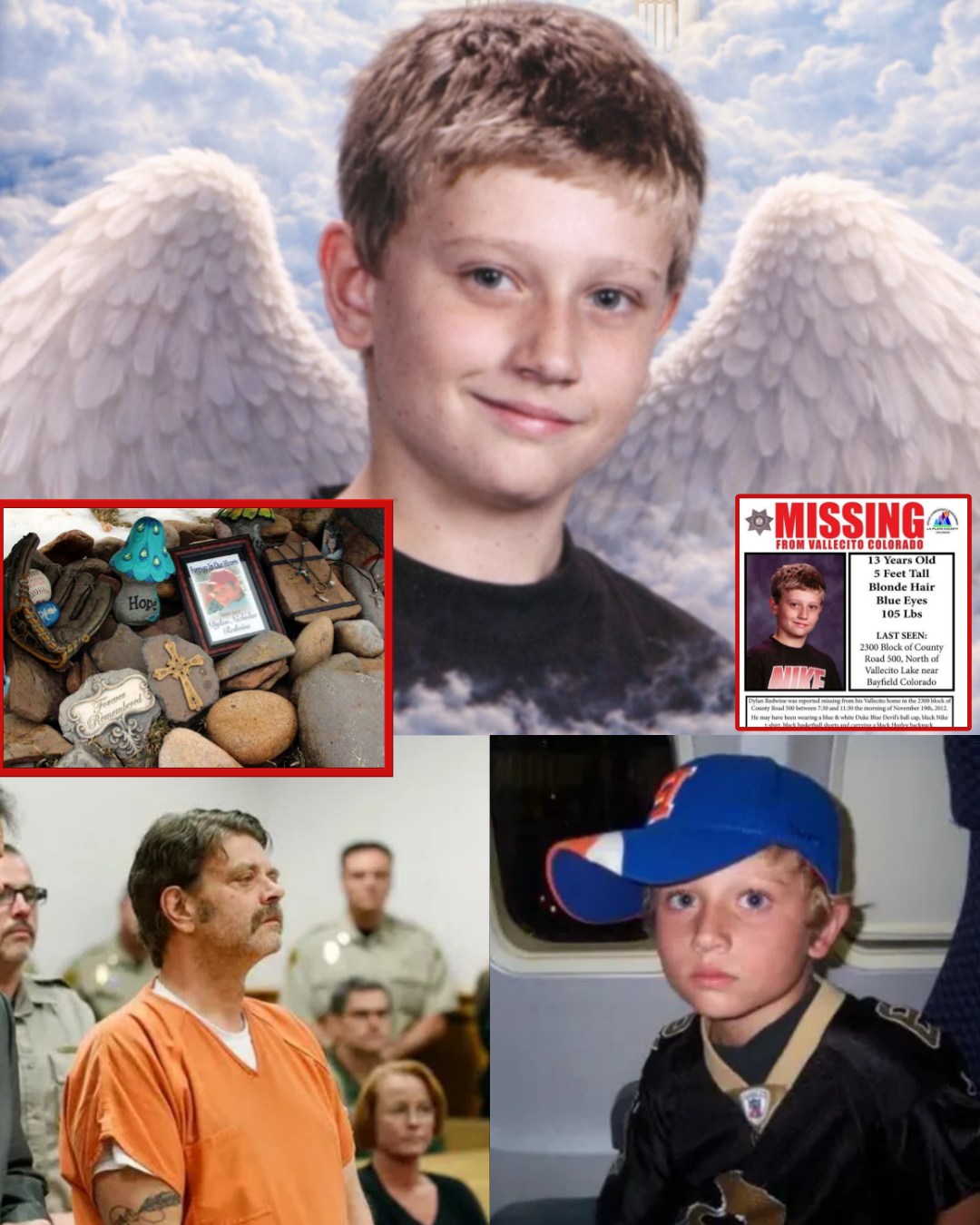
Dylan Redwine Case: How a Child’s Warnings Were Ignored Before His Death in Colorado.
He was known for his emotional depth, artistic interests, and sensitivity to the people around him.
After his parents’ divorce, Dylan lived with his mother, Elaine Hall, in Colorado Springs, where he felt more secure.
Those close to Dylan often described him as intelligent, reflective, and more perceptive than most children his age.
From an early age, Dylan struggled deeply with his relationship with his father, Mark Redwine.

His discomfort was not subtle or implied, but clearly expressed in words and behavior.
Dylan told people directly that his father frightened him and made him feel unsafe.
These fears were shared with adults, documented in records, and discussed openly.
Despite this, his concerns were not treated as serious warnings requiring intervention.
In November 2012, a court order required Dylan to spend Thanksgiving break with his father.
The visit was scheduled to take place in the rural area of Vallecito.
Dylan strongly objected to the visit and expressed distress about going.
He told people his father was mean and emotionally intimidating.
He said clearly that his father made him uncomfortable and afraid.
Those warnings were acknowledged but ultimately dismissed.
For Dylan, the danger did not come from an unknown person or situation.

It came directly from a legal decision meant to enforce parental rights.
On November 18, 2012, Dylan arrived at his father’s home for the court-ordered visit.
It was supposed to be a short stay during a school holiday.
He expected to return to his mother’s home after the break ended.
According to prosecutors, while inside the house, Dylan discovered disturbing photographs.
The images showed his father in fetish-related scenarios involving women’s lingerie.
Investigators later argued that Dylan confronted his father about what he had seen.
They believe Dylan threatened to tell others, including his mother, about the images.
That confrontation is believed to have changed the course of events.

Prosecutors said it triggered panic and fear in Mark Redwine.
On the morning of November 19, 2012, Dylan was suddenly gone.
Mark Redwine claimed Dylan woke up, ate breakfast, and walked away on his own.
No one else ever saw Dylan leave the house that morning.
There was no physical or eyewitness evidence supporting Mark’s account.
When Dylan failed to return home as expected, concern escalated rapidly.
His mother contacted authorities and reported him missing.
A large-scale search effort began almost immediately.
Volunteers joined law enforcement officers in the search.
Search dogs were brought in to track scent and evidence.
Helicopters scanned the rugged terrain surrounding the area.
From the earliest days of the investigation, suspicion focused on Mark Redwine.
His behavior raised concerns among investigators and search teams.
He gave statements that changed over time and lacked consistency.
He refused to fully cooperate with law enforcement requests.
He failed a polygraph test administered during the investigation.
Inside the house, investigators uncovered evidence that directly contradicted his story.
Dylan’s blood was found on the living room carpet and couch.

Signs of attempted cleanup were also documented at the scene.
Multiple cadaver dogs alerted inside the home.
Cadaver dogs also alerted inside Mark Redwine’s vehicle.
Despite this evidence, no immediate arrest was made.
Dylan remained officially listed as a missing person for months.
As time passed, hope gradually gave way to dread.
In June 2013, partial remains were discovered near Vallecito Reservoir.
The discovery confirmed that Dylan was no longer alive.
Two years later, in 2015, additional remains were found miles away.
The condition of the remains showed evidence of severe trauma.
Prosecutors stated the findings indicated blunt force injuries.
They also noted post-mortem damage consistent with animal scavenging.
Authorities concluded Dylan had been killed inside the home.
They determined his body had been dismembered after death.
They argued his remains were disposed of in multiple remote locations.
In 2017, nearly five years after Dylan disappeared, Mark Redwine was arrested.

He was formally charged with first-degree murder.
He was also charged with child abuse resulting in death.
The arrest brought a sense of accountability but renewed grief for Dylan’s family.
At trial, prosecutors presented a clear and methodical narrative.
They argued Dylan confronted his father about the photographs.
They argued Mark panicked and acted to protect himself.
They argued a child was killed to preserve an adult’s secrets.
The defense claimed Dylan ran away from the house.

They suggested an unknown person was responsible for the murder.
The jury rejected that explanation after reviewing the evidence.
The physical and forensic evidence directly contradicted the defense theory.
In 2021, Mark Redwine was convicted by a jury.

He was sentenced to 48 years to life in prison.
The sentence means he will likely spend the rest of his life incarcerated.
For Dylan’s mother, the verdict did not bring true closure.
Elaine Hall has spoken publicly about her son’s character and intelligence.
She described Dylan as sensitive, honest, and emotionally aware.
She emphasized repeatedly that he tried to speak up about his fear.
She said his warnings were ignored by the very systems meant to protect him.
Dylan was not a child who vanished without warning signs.
He expressed discomfort clearly and consistently over time.
His voice was overshadowed by legal procedures and assumptions.
His case became a powerful example of systemic failure.
It raised serious questions about how custody decisions are made.
It highlighted how children’s expressed fears are often minimized or dismissed.
Community members followed the case closely over many years.
Vigils and memorials were held to honor Dylan’s life.
Public discussions focused on prevention, accountability, and reform.
Dylan’s life was far more than the circumstances of his death.
He loved art, creativity, and self-expression.

He was remembered for his depth, kindness, and quiet strength.
Those memories remain central to who he was as a person.
His case continues to be referenced in discussions about custody reform.
Advocates point to Dylan when calling for meaningful legal change.
They argue that children’s voices must be taken seriously.
The Redwine case showed that danger does not always come from strangers.
Sometimes it comes from within a family structure.
Acknowledging that truth is deeply uncomfortable.
Ignoring it can have devastating consequences.
Dylan Redwine did not simply disappear without explanation.

He was failed by multiple layers of protection.
Each ignored warning played a role in the final outcome.
Remembering Dylan means confronting those failures honestly.
He was a child who deserved safety and belief.
Honoring him means listening when other children say they are afraid.